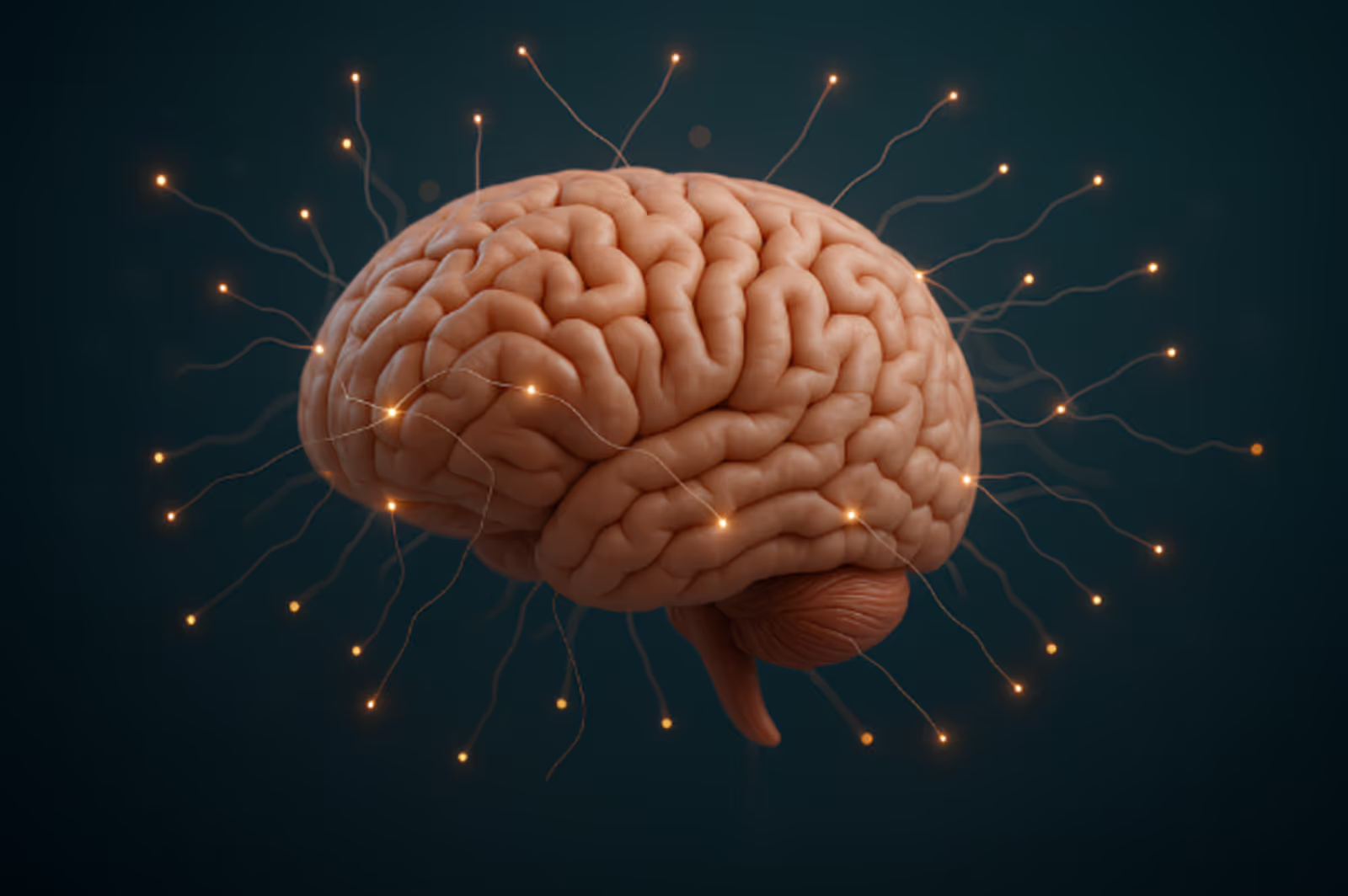
The jaw is downstream of the system that controls it. TMJ pain that returns after every mouthguard, every splint, every round of Botox isn't a stubborn jaw problem. It's a signal that the upstream input never changed.
This is the pattern we see most often with TMJ: temporary relief, then return to baseline. The treatments are working at the symptom layer. The driver lives one level up, in the upper cervical spine, the brainstem, and the nervous system keeping the jaw locked.
What TMJ actually is
The temporomandibular joint connects the lower jaw (mandible) to the temporal bone of the skull. It's one of the most-used joints in the body and one of the most heavily innervated by the trigeminal nerve. Around it sit four muscles of mastication, the masseter, temporalis, and the medial and lateral pterygoids, that move the jaw for chewing, speaking, and swallowing.
TMD (temporomandibular dysfunction) is what happens when those muscles, the joint, or both fall out of normal coordination. The classic signs:
- Jaw tightness or pain at rest
- Clicking, popping, or locking when chewing
- Headaches that start at the temples or behind the eyes
- Ear pain or fullness with no infection present
- Clenching or grinding, especially overnight
- Neck and shoulder tension that tracks with jaw symptoms
These symptoms typically get treated as a localized problem. They aren't local. They're system-level.
The trigeminocervical connection
There's a specific anatomical reason TMJ and the upper neck travel together: the sensory neurons of the trigeminal nerve and the upper three cervical nerves converge on the same set of brainstem neurons in a region called the trigeminocervical complex.
What that means clinically: the brain can't always tell whether the signal it's receiving originated in the jaw, the upper neck, or the head. Input from one of these regions can refer pain or tension to another. Chronic upper cervical misalignment shows up as jaw pain. Chronic jaw clenching shows up as neck tension. They share the same circuit.
This is why TMJ patients often have:
- A history of whiplash, head injury, or concussion they didn't connect to the jaw
- Headaches that don't fit a clean migraine or tension pattern
- Tension that radiates from the base of the skull into the temples and jaw
- Symptoms that flare during stress, when the nervous system shifts further toward sympathetic
The jaw is reading signals the rest of the body is sending it. If the signals say "stay braced," the jaw stays braced.
Why mouthguards, splints, and Botox plateau
Each of these tools works on a real piece of the pattern:
- Mouthguards and splints redistribute occlusal load and protect tooth surfaces from grinding. They don't change the muscle activation pattern driving the clench.
- Botox chemically silences specific muscles. The clench eases until the dose wears off. The signal telling the muscle to clench is unchanged.
- Massage and stretching release the muscle temporarily. The pattern reasserts within hours or days because the brainstem keeps issuing the same instructions.
Each of these is a downstream intervention on an upstream problem. When the upstream input clears, the downstream symptom often resolves with significantly less external management. When the upstream input stays distorted, every downstream tool plateaus.
How the atlas factors in
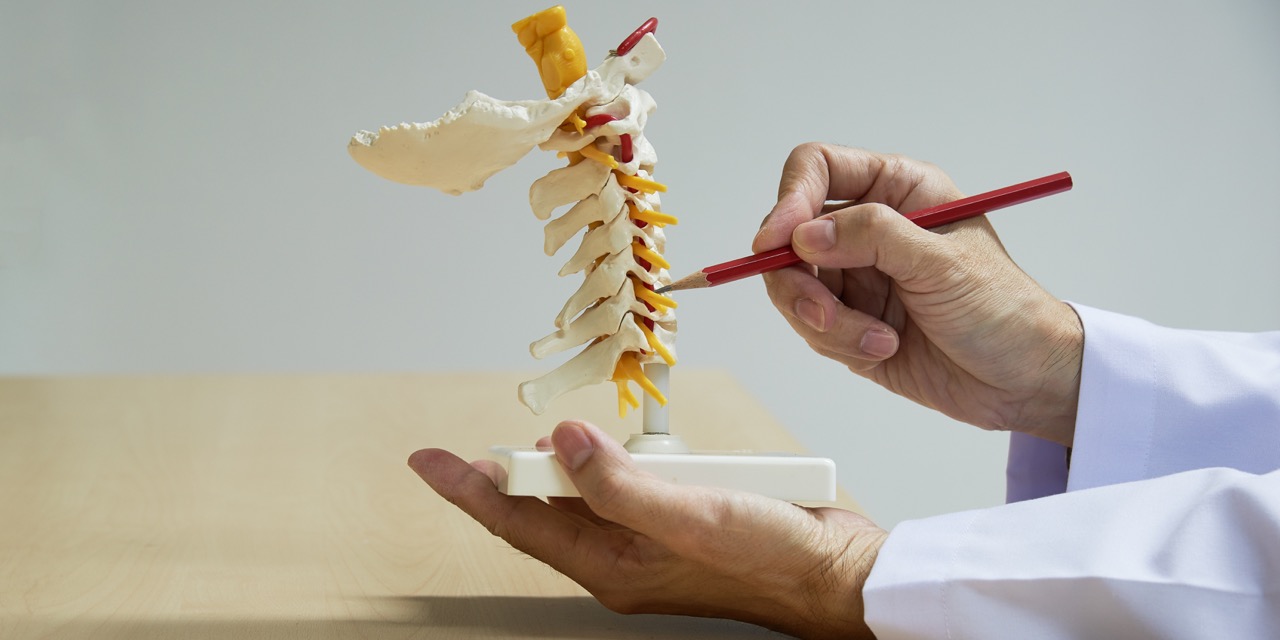
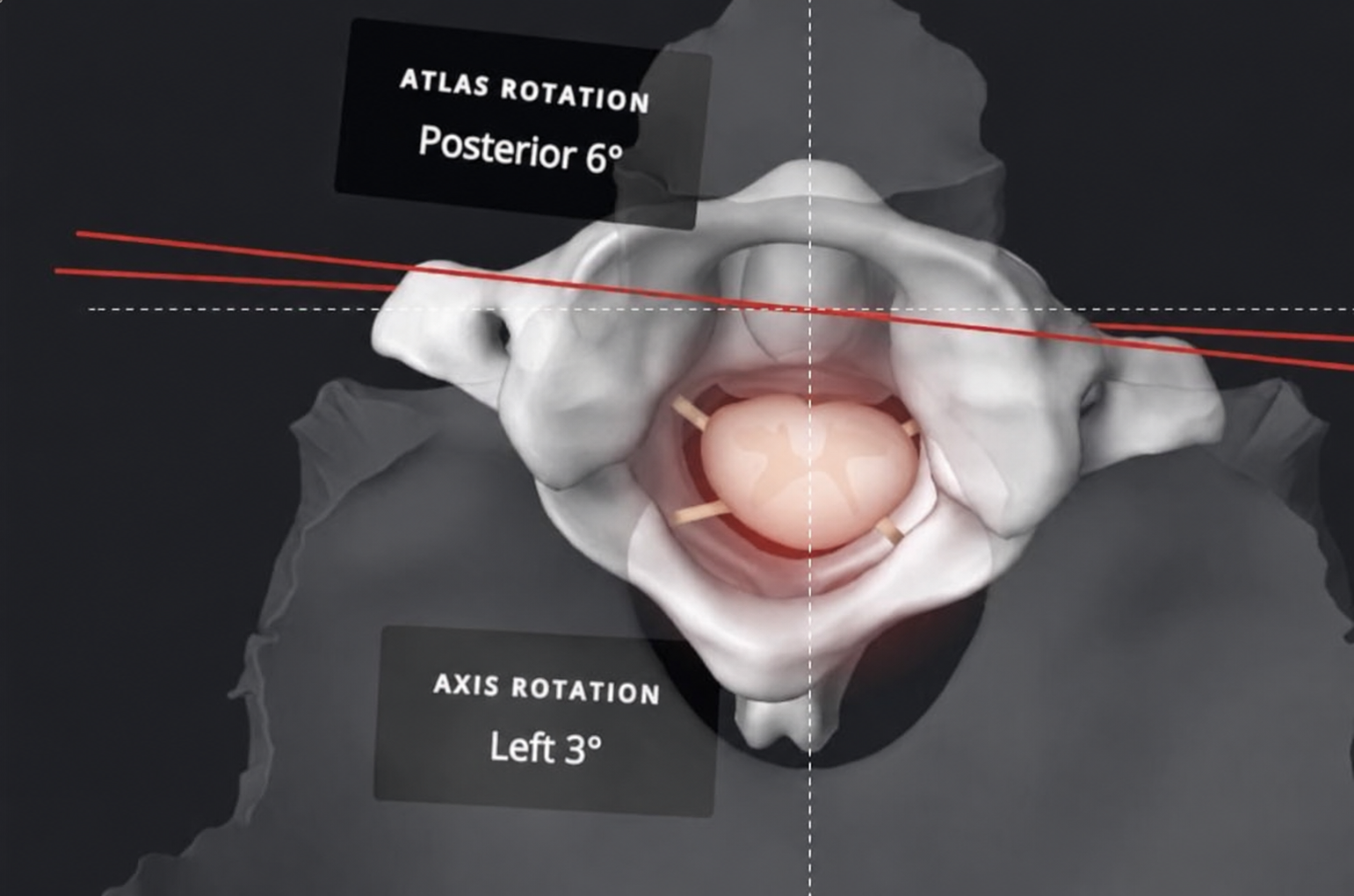
The atlas, the top vertebra in your spine, sits directly around the brainstem. The brainstem is where the trigeminocervical complex lives. It's also where the autonomic system decides moment to moment whether to keep muscles braced or let them release.
When the atlas is misaligned, three things happen at once:
- The structural input the brainstem receives is distorted, so the body keeps reading low-grade threat
- Muscle tone across the face, jaw, neck, and shoulders gets dysregulated, often asymmetrically, which is why TMJ symptoms often present on one side worse than the other
- The autonomic system stays biased toward sympathetic, which keeps the masseter and temporalis chronically activated, even during sleep
This is the mechanism behind nighttime clenching, morning jaw pain, and TMJ patterns that respond temporarily to anything and permanently to nothing.
What we look for
Patients with TMJ get the full clinical baseline: upper cervical imaging plus the three-part autonomic assessment — HRV (parasympathetic capacity), sEMG (chronic muscle guarding), and thermography (autonomic regulation). The sEMG is particularly relevant here. We can map the chronic activation pattern in the masseter and temporalis directly, and watch it change as the corrective work proceeds.
If the assessment indicates upper cervical involvement, we use Atlas Orthogonal: an instrument-based, low-force correction calculated from the imaging. No twisting, no rotation, no manipulation of the neck. The corrective force is measured, not estimated.
When jaw symptoms are also being driven by muscular guarding patterns that have built up around the structural pattern, we use Muscle Regen (AMIT) to release them. LLLT laser therapy supports localized tissue work at the joint when indicated.
What measurable progress looks like
Recovery from chronic TMJ is rarely linear, but the markers move together:
- sEMG showing the masseter and temporalis activation pattern releasing on the side that was guarded
- Morning jaw soreness decreasing in frequency and intensity
- Headaches at the temples shortening in duration and lengthening in interval
- Clicking or popping reducing as muscle tone normalizes around the joint
- Sleep improving as the nervous system stops bracing through the night
- HRV trending up as the autonomic baseline shifts
These markers move together because they're all expressions of the same underlying pattern.
The point
TMJ isn't a jaw problem. It's a nervous system problem expressing itself at the jaw.
Symptom-level care has a place. Mouthguards protect teeth. Splints redistribute load. Botox can interrupt acute clenching cycles. None of these change the signal driving the pattern. When the structural input clears, the jaw stops getting the instructions to brace, and the rest of the system gets quieter alongside it.
If you've been cycling through TMJ treatments and the relief keeps wearing off, the input may not be where you think. We baseline every new patient with upper cervical imaging plus HRV, sEMG, and thermography, so we can see what the system is actually doing before we recommend anything.