If you've been chasing mobility for years and the gains keep evaporating, the missing piece isn't a better stretch or a more aggressive technique. It's that mobility is a nervous system permission, not a joint range — and the permission isn't being granted because the system has a reason to withhold it.
This piece is for people who've done the mobility work, the yoga, the prescriptions from physical therapy, and still feel like specific regions of their body won't fully unlock. The frame here is the Human Operating System view: real mobility is the output of integrated nervous system function, not just the joint range you can produce in a stretch.
How the nervous system controls movement
Every voluntary movement is a calculation. The nervous system processes input from joint receptors, muscle spindles, skin, vestibular and visual systems, and a model of what the body looks like in space. It then permits movement to the extent it considers that movement safe and supported.
When the system perceives a region as needing protection — because of prior injury, current pain, structural compensation, or chronic autonomic dominance — it limits the range it'll grant. The limit isn't about tissue length. It's about what the nervous system is willing to allow.
This is why range of motion can change dramatically within a single session. The tissue didn't grow. The nervous system temporarily relaxed its protective limit. The reason that change doesn't always persist is that the protective state often reasserts as soon as the conditions that produced it return.
What "stiff" usually actually means
When people describe themselves as stiff, the experience is real. What they're feeling is the result of protective neural output: the nervous system holding tonic tension in specific regions, often as compensation for something else.
The most common upstream drivers we see in the practice:
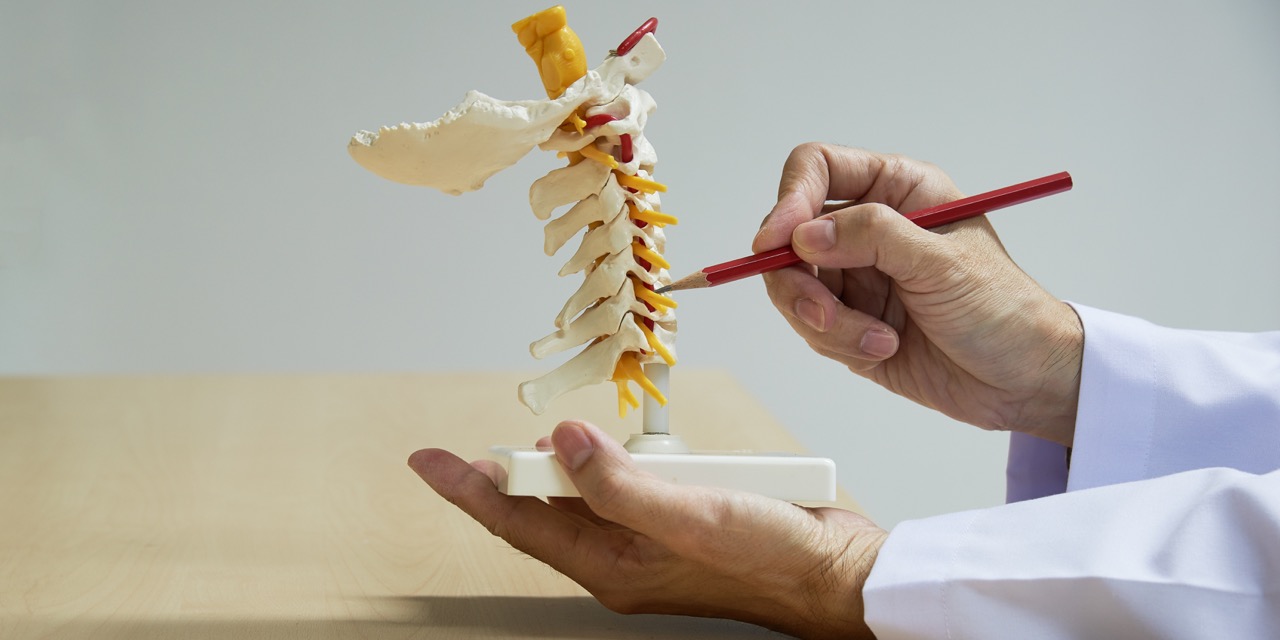
Structural misalignment in the upper cervical spine. The atlas-axis region houses dense proprioceptive input to the brainstem. When mechanics there are off, the surrounding musculature compensates continuously to stabilize the head. That compensation pattern shows up throughout the rest of the body as restricted neck, shoulder, and thoracic mobility.
Post-injury compensation patterns. Old injuries — concussions, whiplash, fractures, surgeries — leave the nervous system holding protective patterns long after the tissue has healed. The body adapts to move around the damaged region, and the adaptation becomes the new default.
Chronic sympathetic dominance. Sustained autonomic activation from any source raises baseline muscular tension system-wide. The whole muscular system runs slightly more contracted than it should at rest, and movement feels constrained because the resting tone is elevated.
Repetitive postural load. Hours of seated work, repetitive movement patterns, asymmetric loading from daily tasks — these don't cause stiffness in the way mechanical stress would damage a hinge, but they reinforce neural patterns that become the system's default.
In each case, the felt experience is restricted movement. The driver is upstream of the muscle being stretched.
In Short: Real mobility is governed by nervous system permission, not tissue length. When the system has reason to maintain protective tension, that tension persists despite stretching. Improving mobility durably requires addressing what's keeping the protective state elevated.
Where this fits in the Human OS framework
Mobility is an output in the Inputs → Interference → Output model. When mobility is restricted, the cause is usually interference between input and output.
Interference at the structural layer (upper cervical misalignment, joint pathology) feeds the nervous system continuous reason to maintain protective tension.
Interference at the autonomic layer (chronic sympathetic dominance) raises tonic tension everywhere.
Interference at the behavioral layer (compensation patterns, habitual posture) reinforces neural maps that default to the restricted pattern.
Addressing the interference layer is what makes mobility durable. Stretching is an input that briefly reduces protective output; it doesn't change the interference. The work compounds when the interference is also being addressed.
What chiropractic care specifically addresses
The practice focuses on structural interference at the upper cervical spine. The Atlas Orthogonal technique restores the precise relationship between skull, atlas, and axis, using imaging-derived measurements to calculate a specific corrective force vector. When that relationship is restored, the chronic compensatory tension downstream often unwinds.
What that looks like clinically: neck rotation that hasn't been full in years returns. Thoracic mobility that yoga couldn't unlock becomes accessible. The same stretching practice that wasn't producing lasting results starts compounding. The work didn't change; the system has more capacity to integrate it.
This isn't every patient's experience. Some people have mobility restrictions that don't have a structural driver, and structural correction won't move them. The assessment is what tells us whether structural input is the missing piece.
What we see in practice
The mobility-focused patients who come in usually have one of two patterns.
Persistent regional restriction. A neck that won't rotate. A jaw that won't open fully. A shoulder that's been compensating for a decade. The restriction is focal, asymmetric, and resistant to consistent work. The assessment usually confirms an upper cervical contribution, often with a history of past trauma the patient may not have connected.
Global mobility decline. The whole system feels stiffer than it used to. Stretching that worked at 30 isn't producing the same results at 45. The body feels less responsive across the board. This pattern often tracks back to autonomic dysregulation — chronic sympathetic dominance raising tonic tension everywhere. The assessment captures the autonomic baseline and the structural piece in parallel.
In both cases, the work targets the upstream driver rather than the felt restriction. When the structural component is the answer, the mobility downstream usually responds.
When mobility work alone is enough
Not every mobility restriction has a structural driver. Self-mobilization, stretching, mobility flows, and bodywork are appropriate and often sufficient when:
- Restrictions are acute or situational
- A consistent practice is producing visible cumulative progress
- The pattern is generalized rather than focal and persistent
- There's no significant history of injury or chronic symptoms
Structural assessment is worth considering when:
- Specific regions keep restricting no matter what you put in
- A consistent mobility practice has plateaued despite effort
- History of concussion, whiplash, or other significant trauma
- Mobility issues accompany other autonomic symptoms (poor sleep, low HRV, persistent fatigue)
Schedule your assessment
If you've been doing the mobility work and the same patterns keep returning, the assessment captures what's maintaining them. The first visit is a consultation, full assessment, and upper cervical x-rays. The doctor reviews everything between visits, and the report of findings comes at visit two.
Schedule Your Assessment Today
References
Weppler CH, Magnusson SP. Increasing muscle extensibility: a matter of increasing length or modifying sensation? *Physical Therapy.* 2010;90(3):438-449. doi:10.2522/ptj.20090012
Treleaven J. Sensorimotor disturbances in neck disorders affecting postural stability, head and eye movement control. *Manual Therapy.* 2008;13(1):2-11. doi:10.1016/j.math.2007.06.003
Hack GD, Koritzer RT, Robinson WL, Hallgren RC, Greenman PE. Anatomic relation between the rectus capitis posterior minor muscle and the dura mater. *Spine.* 1995;20(23):2484-2486. doi:10.1097/00007632-199512000-00003